
In the Textbook: see ch. 19, pg. 173
Chart
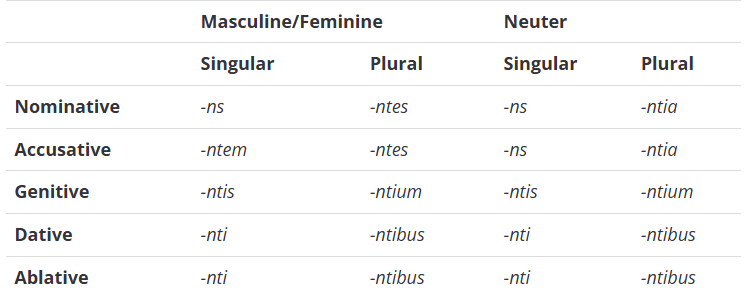
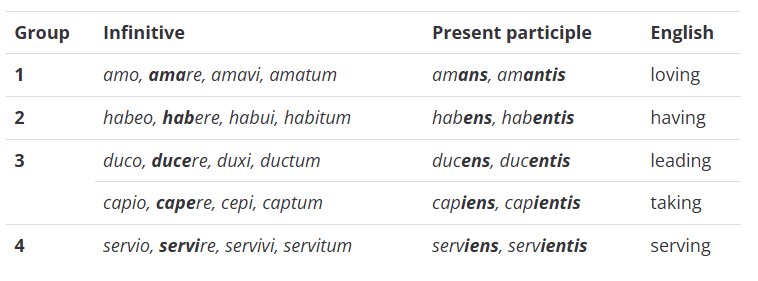
Above, you’ll find the endings of the present participle. Below, you’ll see how the different conjugations of verbs take these endings. For further explanation, see the intro video on the Participles page.
Present Participles in English
Participles in English are far less common than they are in Latin (which is even less common than in Ancient Greek). In English, a verb (i.e. to run) can be changed into a participle (running). This form of the verb can then be used as either (1) an adjective, or (2) a noun.
Examples
There was a running man on our street today.
How many sailing ships were in the British navy?
In Utah, the firing squad is still legal.
The firing of the C.E.O. had quite an impact on the company last year.
The nailing of the Ninety-five Theses sparked that Protestant Reformation.
At Buckingham Palace, you must go see the changing of the guard.
Note: In English, the substantive (noun) form of the participle is very often accompanied by the Genitive (of the…).
Present Participles in Latin
 The Texan Reformers